
The second quarter of 2026 demonstrated an important lesson for investors: markets can continue to advance even when uncertainty dominates the headlines. Persistent inflation concerns, heightened geopolitical tensions, high energy prices, and evolving expectations for Federal Reserve policy all contributed to periods of market volatility. Despite these headwinds, U.S. equities recovered from a difficult first quarter and continued their longer-term upward trend, leaving the major market indices higher after the first half of the year.
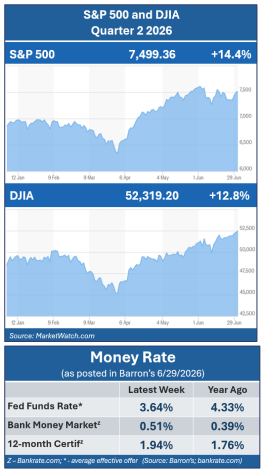
Led by strong corporate earnings, a resilient U.S. economy, and continued enthusiasm for artificial intelligence (AI) and technological innovation equity markets made new highs during the quarter. Both the S&P 500 and Dow Jones Industrial Average (DJIA) indexes experienced healthy gains as the S&P 500 closed the quarter up 14.4% and the DJIA gained approximately 12.8%. Through the first six months of 2026, the S&P 500 has gained 9.6%, and the Dow has advanced 8.9%. (Source: apnews.com; statmuse.com 6/30/26)
One of the most important drivers of equity markets is the direction of corporate America – and it continued to deliver solid results. According to FactSet, on June 26, the estimated year-over-year growth for S&P 500 companies is 23.1%, which would mark the seventh consecutive quarter of double-digit earnings increases and the secondstraight quarter of earnings growth over 20%.
The energy sector was among the largest contributors to market volatility. West Texas Intermediate (WTI) crude oil experienced a 74% volatility rate as it swung between the high $60s and the low $120s per barrel during the quarter. Meanwhile, the U.S. labor market continued to demonstrate resilience as the U.S. Bureau of Labor Statistics stated the unemployment rate remained steady at 4.3% in May.
Overall, the second quarter reinforced an important investment principle: while headlines often create short-term market volatility, long-term market performance is ultimately driven by healthy, long-term focused fundamentals. While volatility remains a normal part of investing, the quarter reinforced the importance of focusing on long-term fundamentals rather than reacting to short-term market noise. As financial professionals, our role is to closely monitor market developments and help ensure your portfolio remains aligned with your broader financial goals.
Inflation & Interest Rates
Key Points:
- The Federal Reserve left the federal funds rate unchanged during the second quarter of 2026, maintaining the target range at 3.50%– 3.75% but they reduced expectations for rate cuts and discussed the possibility of future rate increases.
- Inflation remains above the Fed’s long-term target and continues to be a concern.
At the April FOMC meeting, the final meeting chaired by Jerome Powell, the Federal Reserve held interest rates steady. At the June meeting, the first under newly appointed Federal Reserve Chair Kevin Warsh, policymakers again voted to maintain the target rate range of 3.50%–3.75%, while signaling a more hawkish outlook for the remainder of the year. (Source: CNBC, June 17, 2026)
Consumer spending also remains healthy. According to May data from the Bureau of Labor Statistics, the core Consumer Price Index (CPI), which excludes food and energy, increased 2.9% year-over-year. Geopolitical developments should continue to affect energy prices and therefore they will also influence inflation trends. (Source: Bureau of Labor Statistics)
KEY TAKEAWAYS
- After a rough start to the year, the second quarter brought new highs in equities led by strong corporate earnings, a resilient U.S. economy, and continued enthusiasm for artificial intelligence (AI) and technological innovation.
- The Federal Reserve adjusted its stance on future interest rate adjustments this year but kept interest rates unchanged at 3.5% – 3.75%.
- Oil prices rose heavily during the quarter and then began to subside at the quarter’s end with hope of a possible resolution with Iran.
- Focusing on your long-term goals and staying the course of a well-structured investment approach can help you stay grounded and confident during these times of uncertainty.
- We are here for you. Please reach out with any questions or concerns. Your financial well-being is always our highest priority!
Looking ahead, currently the prospect of a rate cut in 2026 appears increasingly unlikely. In fact, the possibility of a rate increase later this year has gained momentum. The path forward will largely depend on the trajectory of inflation, labor market conditions, and overall economic growth. Interest rates and inflation remain critical factors in financial planning and investment decision-making so we will continue to monitor them.